
Checking for a Warrant in South Carolina
Checking for a warrant in South Carolina means working a chain of contacts. No public statewide search covers every active warrant. Start from whatever case lead you have, then confirm with the issuing court and the office assigned to serve the papers. The Judicial Branch's Court Roster Search routes by county, city, or ZIP, which is handy when you do not know which court holds the case. A second tool, the Trial Court Public Index, may show case information for participating courts. It still does not certify whether a warrant is currently active or served. County sheriffs and city police keep their own service records, and lower-court matters often stay entirely local. So expect to make more than one call before you have a firm answer on an outstanding warrant.
- Start by identifying the county or city court; South Carolina has no comprehensive public statewide warrant search.
- Search the Trial Court Public Index for a case lead, then note the court agency and case number.
- Open the county route below and contact the sheriff or serving agency for local warrant information; a public sheriff search may be partial or stale.
- For a ticket or city matter, ask the issuing Magistrate or Municipal Court clerk and the city police where service records are held.
- If online records are unavailable, send a narrow written SC FOIA request to the record holder.
- If a warrant may exist, ask the issuer about status and court-directed options; consult a South Carolina lawyer before appearing.
South Carolina Has No Public Warrant Index
South Carolina publishes no single public database of active warrants. Its official court, law-enforcement, and public-safety systems each do something narrower. The Trial Court Public Index searches case information, but only for participating courts. SLED CATCH is a paid criminal-history service, and it expressly excludes wanted-person information. SLED CJIS, SCIEx, and NCIC sit behind restricted access for authorized criminal-justice users only. Treat none of these as a public warrant register, because none is one.
Search result limit: A blank Public Index, CATCH, ticket-search, sheriff, or curated fugitive result does not prove that no South Carolina warrant exists.
The record of a warrant stays with the court that issued it, while the county sheriff, municipal police, or another authorized officer may hold the service details. A City Municipal Court matter can sit entirely outside a county sheriff's list. The state itself provides case routes and restricted agency systems rather than one public status answer. For a fuller look at this split, see the South Carolina warrant system page. Any specific case still comes down to its issuing clerk and serving office. Local routes begin with the court level and the municipality involved, never with an assumption that agencies share one public database. Note: A statewide case tool can help identify a court without confirming whether the warrant's present service status.
Inside the South Carolina Statewide Warrant System
No public South Carolina database searches active warrants across the board. The closest statewide public option is the Trial Court Public Index, which displays case information for participating courts. It can help you locate a court, a party, and a docket. What it cannot do is guarantee that a case status matches a warrant's status. Municipal participation is only partial, and the index is not a warrant-reporting roster. The other statewide systems are narrower still. SLED CJIS, SCIEx, and NCIC support authorized criminal-justice work, not public self-queries. SLED CATCH is a criminal-history check that explicitly excludes wanted-person information. The traffic-ticket search and SCDMV license services deal with citations and driving privileges, not with whether a court warrant is active.
| Public Index Control | What It Searches | Important Limit |
|---|---|---|
| Court Type and Court Agency | Selects a participating court source | Municipal participation is partial |
| Case Number or Indictment Number | Finds a docket with a known identifier | Case identifiers are not warrant numbers |
| Last Name / Business and First or Middle Name | Searches a party name by contains or starts-with choices | A match still needs court confirmation |
| Case Type, Action Type, and Date Range | Narrows the case-information results | Does not establish current service status |
A search can return the party name and type, case number, filing date, case status, and disposition date. Case type and court agency may appear too. For system roles and access boundaries, see the South Carolina warrant system page.
South Carolina CATCH Excludes Wanted Data
SLED CATCH is a criminal-history service, not a warrant lookup. The online search asks for a last name, first name, and date of birth; a Social Security number is optional. SLED states plainly that wanted-person information is excluded. The standard online fee is $25 plus the current service fee, while eligible charity or school checks carry an $8 base fee plus the service charge. SLED's current page lists a $1.43 service fee effective July 1, 2026, even though older body text still says $1. Those charges buy a criminal-history product, not a South Carolina warrant record, so never treat a CATCH result as proof that a warrant exists or has been recalled. Mail requests have their own accepted-payment and mailing instructions, and certified or notarized copies must be requested separately. The paper form shows no processing-time promise and no government-ID field. The official SLED CATCH service explains the product's scope. For a court warrant, confirm with the issuing clerk and serving agency instead.
South Carolina Court Search Routes Geography
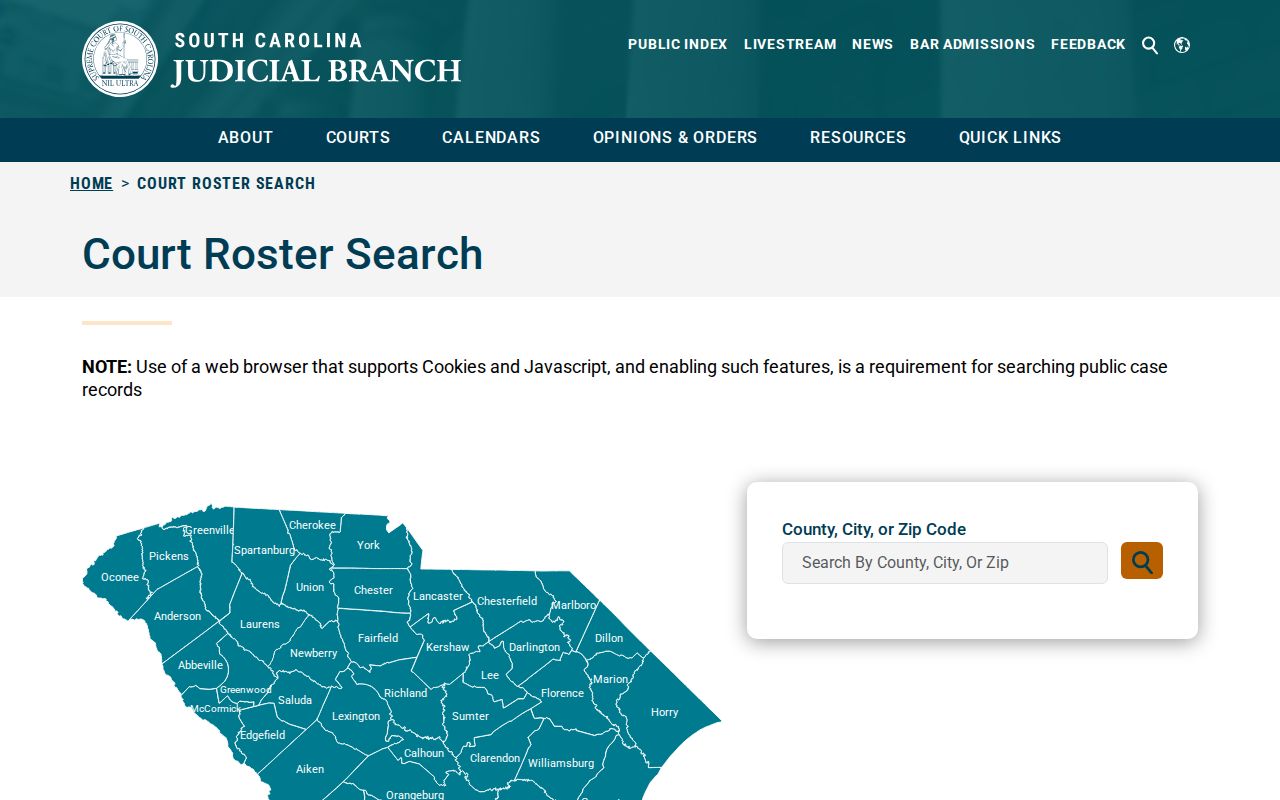
The Judicial Branch Court Roster Search takes a county, city, or ZIP and points to court rosters and record links across South Carolina. It helps you figure out where to ask. It is not a warrant index. No case details are needed to use this locator. Begin with the official roster search when the issuing court is unclear.
A separate Courthouse Search supplies courthouse and contact information for South Carolina. It can narrow the correct county office once the case location is known. This page supports contact discovery, not warrant-status checking.
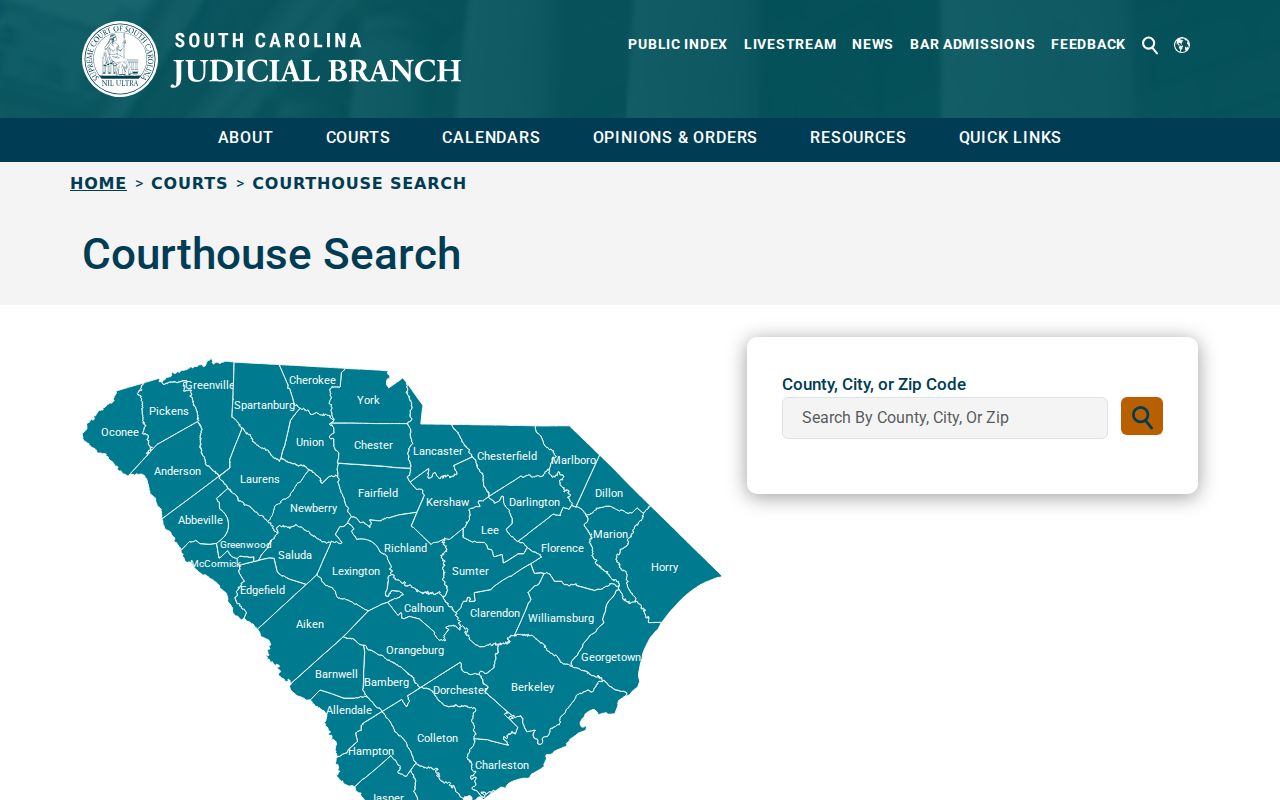
Match the court listed on a case result to the clerk who actually holds the file. A city case may still run through the municipal court, even when you know the county. Note: Court Roster Search and Courthouse Search point you to an office; neither one screens for or clears a South Carolina warrant.
South Carolina Warrant Types
South Carolina courts use different process for different jobs. An arrest warrant rests on a sworn allegation and a probable-cause review. A bench warrant grows out of an existing case, often after a missed appearance or a violated order. Search warrants let officers look for evidence described in the order. Family Court can issue support-related process, and fugitive warrants answer another jurisdiction's demand. Which court issued it, and which office keeps the record, depends on the case.
| Warrant Type | How It Arises | Who Issues It |
|---|---|---|
| Arrest warrant | Sworn complaint or affidavit supports probable cause for custody | Magistrate or another judge authorized by law |
| Bench warrant | Missed hearing, order violation, or failure to comply | The court handling the existing case |
| Search warrant | Authorizes a search for specified evidence | Judicial officer with statutory authority |
| Family or support warrant | Enforces a qualifying Family Court order | Family Court |
| Fugitive process | Addresses a person wanted by another jurisdiction | South Carolina court under extradition procedure, or federal court for a federal warrant |
- Issuing court
- The court that authorizes process and maintains the case record.
- Serving agency
- The sheriff, municipal police, or other authorized office assigned to execute process.
- Return
- A record of what the serving officer did with the process; it may be separate from the case's public status.
South Carolina's current public forms label the common failure-to-appear process a "Bench Warrant after Failure to Appear" or a "Bench Warrant after Trial in Absentia." "Capias pro fine" is not a verified statewide label for ordinary traffic nonappearance. A uniform ticket is just a charge and an appearance notice, not a warrant itself.
South Carolina Traffic Holds Are Separate
One traffic ticket can trigger several consequences, and they are not the same record. Under S.C. Code §56-25-40(b), willfully failing to appear on a Uniform Traffic Ticket without required bond or a continuance is a separate misdemeanor, punishable by up to $200 or 30 days. A missed date does not mean a warrant automatically issued. Whether one did depends on that case and its process. On the license side, §56-25-20 lets SCDMV suspend or refuse renewal once qualifying noncompliance is reported, so the court or authority handles citation compliance while SCDMV handles driving privileges. The general reinstatement fee is $100 per suspension unless another fee applies. Paying a ticket and restoring a license are separate steps, and neither one alone proves a warrant was recalled. For a quick check, the Judicial Branch Traffic Ticket Search covers supported summary-court matters and participating municipal tickets. For the warrant question itself, contact the issuing Magistrate or Municipal Court, then confirm any local service record with the sheriff or city police.
A South Carolina DMV suspension is not proof of an active court warrant, and an active warrant need not appear as a license hold.
Inside a South Carolina Warrant Record
A South Carolina warrant record may tie together the case, the issuing court, the judicial officer, the alleged offense, any bond order, and the service return. No single statewide results page guarantees all of that appears. A blank court form shows what the court can record. It does not prove a particular item is online.
| Warrant Number | No statewide format A local court form may assign a number or barcode. |
|---|---|
| Case Number | General Sessions pattern: YYYYGSCC#####. Summary-court pattern: YYYYACC########. These are case identifiers, not warrant numbers. |
| Party and Charge | Named party, alleged offense, statute or classification, and the sworn basis where releasable. |
| Issuing Court | General Sessions, Magistrate, Municipal, Family, or another court with authority over the matter. |
| Bond and Conditions | Terms set by the court; South Carolina has no single statewide warrant bond schedule. |
| Status and Return | Local terms may reflect service, return, recall, or disposition; there is no universal status-code dictionary. |
Public Index case status is not the warrant's status. Descriptors, juvenile information, sealed material, and investigative details may be withheld or redacted. Ask the South Carolina court what the particular record holds.
South Carolina's 2026 Inventory Has Limits
A July 2026 report from the prosecutors counted 168,043 pending South Carolina General Sessions warrants through July 1. Treat that figure carefully. It covers one court tier only, so it is not a count of every active warrant in the state. The report itself says some matters sit in diversion or treatment programs or have moved to other courts, which makes the total a workload snapshot rather than a clean count of executable process. And the number stops there. No verified statewide total exists for Magistrate, Municipal, Family Court, federal, or corrections-related warrants. The age bands in the report add context for General Sessions workload, but they cannot tell you whether one particular warrant is still active, when a county site refreshes, or how many warrants other courts hold. The prosecutors' July 2026 report gives the date and the scope. A question about a specific warrant still goes to the issuing Clerk of Court or summary-court clerk.
South Carolina Rule 118 Bench-Warrant List
South Carolina Criminal Rule 118 puts the county Clerk of Court in charge of a General Sessions list of active bench warrants, with each defendant's name, issue date, and status. The clerk reports count and age information to the chief judge, and originals or certified copies go to the proper law-enforcement agency. Service attempts and returns are recorded for the case. Keep the rule's limits in view, though. Rule 118 is court administration, not a public warrant search, and its list is not a statewide feed. It does not cover Magistrate, Municipal, Family Court, federal, or sheriff records. A General Sessions case result should still be followed by a call to the county Clerk of Court and, when useful, the serving sheriff. The process can also change by court order. If a judge lifts or dismisses a bench warrant, the clerk sends disposition information to law enforcement and the solicitor under the rule. Even then, ask the court and the agency whether the action made it into their current files. South Carolina Criminal Rule 118 explains the administration and service steps. Note: This local General Sessions list does not make an empty statewide case search a warrant clearance.
South Carolina Warrant Records and Public Access
Access to South Carolina records turns on who holds the item and whether a court rule or statute protects it. The South Carolina Freedom of Information Act (SC FOIA), Title 30, Chapter 4, governs public bodies, with exemptions and separate court-access rules. Send a written request to the agency holding the record. It should name the county or city, the known case number or date, and the record sought.
Key Rules:
SC FOIA, Title 30, Chapter 4 sets written-request procedures, response periods, actual-cost fees, and exemptions.
S.C. Code §30-4-40(a)(3) and (b) allows limited withholding for specified law-enforcement harms and requires release of reasonably separable nonexempt material.
SCACR Rule 10 governs court public access and protected or sealed court materials.
Act 205 (2026) amended confidentiality rules for juvenile records and identifying law-enforcement information.
S.C. Code §14-7-1750 permits a state grand-jury indictment to remain sealed until custody or release pending trial.
South Carolina's FOIA sets firm clocks. An agency must decide within 10 business days, or 20 for records more than 24 months old. After approval, production follows within 30 calendar days, or 35 for older records. Fees for search, retrieval, redaction, and copying stay at reasonable actual cost, and any deposit is capped at 25% of the expected total. Exemptions can trigger a denial or redaction, and juvenile and sealed records face their own restrictions. Court rules govern Public Index access, and a sheriff's local search may come with its own accuracy warning. A records response is never real-time warrant confirmation.
South Carolina Warrant Amnesty Is Local
South Carolina runs no statewide warrant-amnesty program, and there is no shared annual roundup calendar. City events that made headlines were one-time local affairs. Columbia Police announced its Spring Forward Amnesty in May 2021, covering eligible Columbia Municipal Court matters; that window has closed. The 2026 SCDMV Driver Suspension Eligibility Week took a different track entirely. It targeted qualifying license suspensions, and applicants still had to meet other reinstatement conditions and pay applicable fees. It did not recall a bench or arrest warrant, wipe out every traffic balance, or build a statewide FTA lookup. If a South Carolina court later announces a local resolution event, read that court's own notice for eligibility, excluded charges, dates, and what action actually recalls the warrant. There is no statewide date, reduced warrant fee, or shared city-court participation list. For current status, ask the issuing court and the serving agency. A past event or an online payment page is not a present route to clearing a warrant. Columbia's 2021 announcement stands as a dated example, and the 2026 SCDMV notice deals with suspension eligibility, not amnesty. Note: a dated license-relief event does not change a court's warrant record or create statewide FTA coverage.
Resolve a South Carolina Warrant Through Court
South Carolina has no statewide warrant-clearing desk or universal self-surrender window. The issuing court alone controls recall, bond, and the next hearing. Posting bond may win release while the case stays open, but it does not dismiss the charge or lift a DMV suspension on its own.
- Identify the issuing court, county or city, and case number from paperwork or a public case lead.
- Ask the clerk whether the warrant is active, what motion or appearance the judge requires, and whether counsel should arrange it.
- Confirm any bond amount, payment type, location, and service instructions with the court and sheriff or city police before traveling.
- After the court acts, request disposition confirmation and ask whether notice went to the serving agency; check a traffic license hold separately with SCDMV.
- If online records are missing or restricted, consider a narrow SC FOIA request or ask a South Carolina lawyer about the case.
The state offers no recall form, walk-in promise, fixed processing interval, or universal bond amount. Paying a fine or getting an empty search result does not mean the warrant is gone. Note: the issuing South Carolina court controls recall and hearing instructions, and no statewide self-surrender process exists.
South Carolina Warrants by County
South Carolina offers 46 county routes, yet the warrant itself always stays with the issuing court and the agency serving it. The six largest counties by 2020 Census population appear below. Each link opens that county's hub, where local court and sheriff routes can be sorted out. Treat the ranking as a dated Census reference, not a current population estimate or proof that every county posts a complete online warrant list.
Greenville County
Greenville · Largest county by 2020 Census population; local court confirmation remains necessary.
Richland County
Columbia · City and county courts follow separate routes; the 2021 Columbia amnesty has ended.
Charleston County
Charleston · Its sheriff search warns that results can be stale and do not confirm an active warrant.
Horry County
Conway · Identify the municipality for a city traffic or ordinance matter.
Spartanburg County
Spartanburg · Public Index participation is a case-information route, not warrant certification.
Lexington County
Lexington · Use the local issuing court and sheriff for a current status answer.
Open the directory of all 46 South Carolina counties for every county route.