
South Carolina Active Warrants Explained
South Carolina publishes no comprehensive public search covering every active warrant. The Judicial Branch Trial Court Public Index pulls case information from participating courts, but it is not an active-warrant register. SLED CATCH, a paid criminal-history check, leaves out wanted-person information altogether. County sheriff pages differ from one county to the next, and municipal matters often stay with the city court or its police department. The warrant record itself sits with the issuing court, while a sheriff or other law-enforcement agency handles service. "Active" and "outstanding" are local status labels for process not yet closed by service, recall, or another court action. The state publishes no statewide status-code list and no universal feed from every court to a public site. So a South Carolina case entry, a local search result, and an official court status are three different things. Use each online source as a lead. Then ask the issuing court to confirm the current record before relying on it.
South Carolina Rule 118 Warrant List
South Carolina Criminal Rule 118 requires each county's Clerk of Court to keep a General Sessions bench-warrant record. A bench warrant is court process inside an existing case, often issued after a missed hearing or a violated order. The list carries the defendant's name, the issue date, and the status. Clerks also report warrant counts and age information to the chief judge. That is court administration for one warrant category. It is not a public statewide query that gathers municipal, Magistrate Court, Family Court, and sheriff records. The rule also covers how warrant papers move to law enforcement, how service returns come back, and how the court records dispositions. A clerk can tell you what records exist and whether a public copy is available under the access rules that apply. Don't assume South Carolina's administrative list shows up in the Public Index, or that it covers every active warrant in the state. South Carolina Criminal Rule 118 is the source for this process. It explains who tracks a county General Sessions bench-warrant list, but it does not create a complete public warrant database. Note: Rule 118 names county General Sessions bench warrants only; it does not state that every warrant type enters that list.
How South Carolina Tracks Active Warrants
South Carolina warrant records sit with different offices, and no single statewide list ties them together. The state sets no public refresh schedule for a master warrant search. No coverage table or reporting rule exists either. So an online result usually shows one court or one agency's data from a single point in time. It can lag behind a court order, a service return, or a local correction. That gap matters when you need current answers. A July 2026 prosecutors' report counted 168,043 pending General Sessions warrants on July 1, 2026. Diversion, treatment, and transferred cases sit inside that figure. It is not a tally of every South Carolina active warrant, nor a verified count of executable ones. Read it as a narrow window on one court category, nothing more.
| South Carolina record channel | What it covers | What it cannot establish |
|---|---|---|
| Rule 118 Clerk of Court list | County General Sessions bench-warrant name, date, and status fields; counts and age reporting. | All county, city, family, or traffic warrants in South Carolina. |
| Trial Court Public Index | Participating-court case details and docket fields. | A complete current warrant status or every municipal court. |
| Local sheriff search | Entries a sheriff reports and releases through its own channel. | Other counties, city records, or a no-warrant certificate. |
| SCDPPPS Most Wanted | A curated supervision absconder program. | The full set of active warrants in South Carolina. |
| SLED CJIS and NCIC | Restricted criminal-justice information for authorized users. | A public self-search or public coverage map. |
The split between a statewide index and county records matters. Authorized users may work with restricted systems, but your actual status must still be checked with the South Carolina court and the serving agency.
South Carolina Sheriff's Warrant Search Is Local
A South Carolina county sheriff search is a useful lead, nothing more. The Charleston County Sheriff's warrant form is one representative example. It requires a last name and takes an optional first name. There is no statewide court, county, warrant-number, or status selector. The county's own disclaimer says results may be incorrect or stale, are not an official county record, and do not confirm an active warrant or establish probable cause for arrest. It also warns readers not to act on a result individually. The official page shows the local sheriff heading and a warrant-service contact prompt. It does not represent every South Carolina sheriff's office.
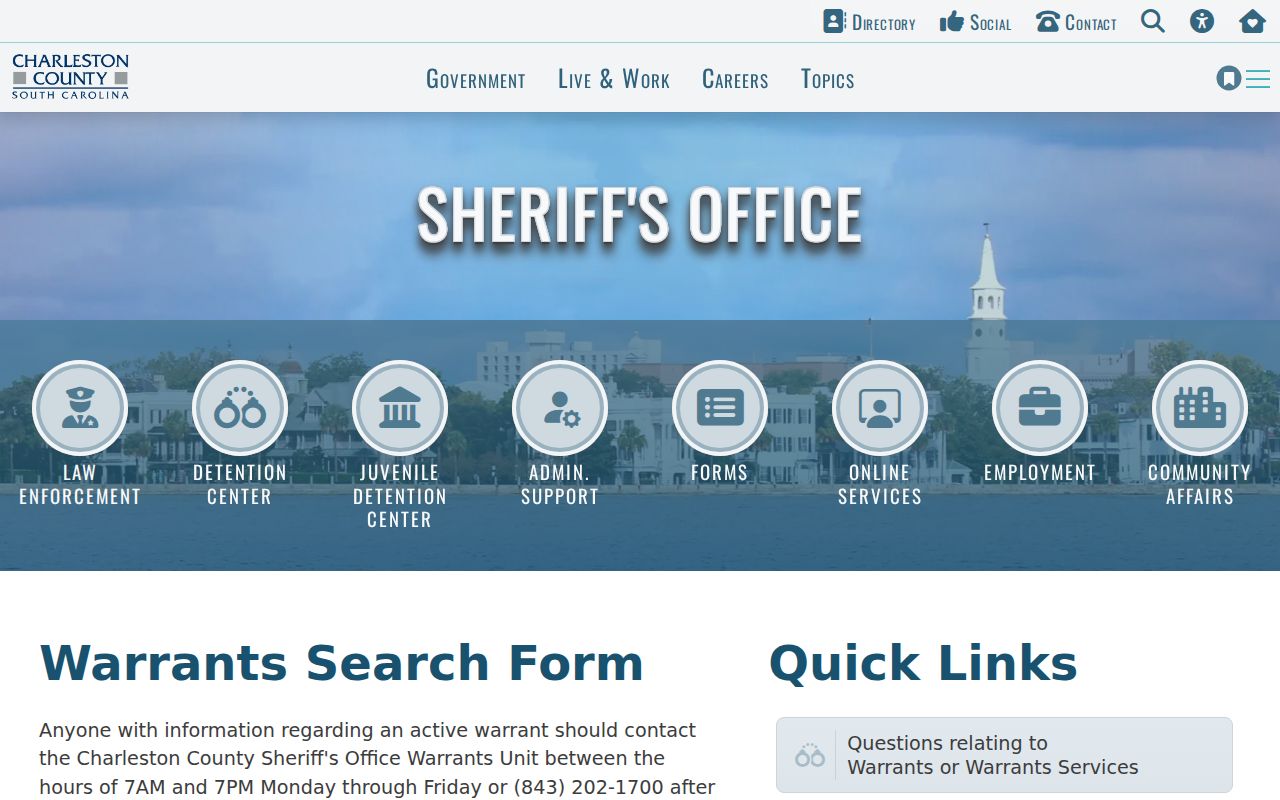
Other counties may publish a different search, route a caller to a warrant unit, or keep the public record at the court. Before acting on any local display, confirm with the issuing court and serving office. Note: Charleston County is one local example, and its warning is not a South Carolina statewide disclaimer.
Inside an Active Warrant Record
South Carolina publishes no standard public format for active-warrant results. The Public Index may show case details, while blank court forms reveal the fields a court can use to issue and track process. Neither guarantees a local online list displays every field. A missing field online does not mean the court record lacks it.
| Issuing court | Identifies the court and county or municipality responsible for the case. |
|---|---|
| Case number | Routes the inquiry to a file. General Sessions and summary-court number patterns are case identifiers, not warrant-number formats. |
| Name and missed setting | A bench-warrant form can identify the defendant and the appearance date or reason cited by the court. |
| Issue and judge fields | Blank process forms carry an issue date and judicial authorization details. |
| Bond condition | A court form may state a previously set bond or release condition. A local search may not display one. |
| Service and return | The officer’s return records an attempt or service result for the issuing court. |
| Status | Rule 118’s clerk list tracks a status field; no uniform public South Carolina status code is published. |
Case numbers in South Carolina follow set patterns. A General Sessions or Common Pleas identifier mixes a year, court letters, a two-digit county code, and a five-digit sequence. Summary courts use a year, an “A,” a county code, and an eight-digit sequence. Handy for finding a case file. The format creates no warrant number of its own. It also cannot tell you whether a warrant is still active. The blank SCCA523 bench-warrant form shows the fields a magistrate fills in: issuer, case, missed date, bond, command, and service return. That schema is not a live list of names, and counties do not post every field online.
Why South Carolina Warrants May Not Appear
A blank result is not proof that no South Carolina warrant exists. The state keeps no public master list. The Public Index covers participating case records only, not every warrant. Some municipal courts opt out entirely, so a city case may sit with the municipal clerk or the police department instead. A sheriff's county warrant search shows only what that one office releases for public view. Timing and secrecy matter too. A warrant can be brand new, sealed, juvenile, or partly withheld under a court rule or a law-enforcement exemption. Court Public Access Rule 10 governs protected court information, and juvenile privacy rules add their own layer. A local site can lag behind reality. SLED CATCH will not close the gap, since wanted-person information is excluded outright and its criminal-history results answer a different question. So treat an online no-result as a first step, not an answer. Identify the likely court and municipality first. Then contact the issuing Clerk of Court, Magistrate Court, Municipal Court, or Family Court, whichever fits your case, and ask the serving sheriff or police unit to confirm its own record. A county list can point your call in the right direction, but it cannot certify the records of all South Carolina courts.
Warrant Roundups and Most-Wanted Lists
South Carolina runs no statewide warrant roundup calendar and no general warrant-amnesty program. A most-wanted page is a curated publicity channel, not a searchable list of active warrants. The SCDPPPS Most Wanted Offenders program centers on parole and probation absconders already under that agency's supervision. It does not reach every South Carolina county, city, court, or warrant. The agency's official page describes the list and explains how to submit a tip. That material changes over time; the agency publishes no update schedule, no total warrant count, and no name-search filter. The page itself names the program and its tip information, nothing more.
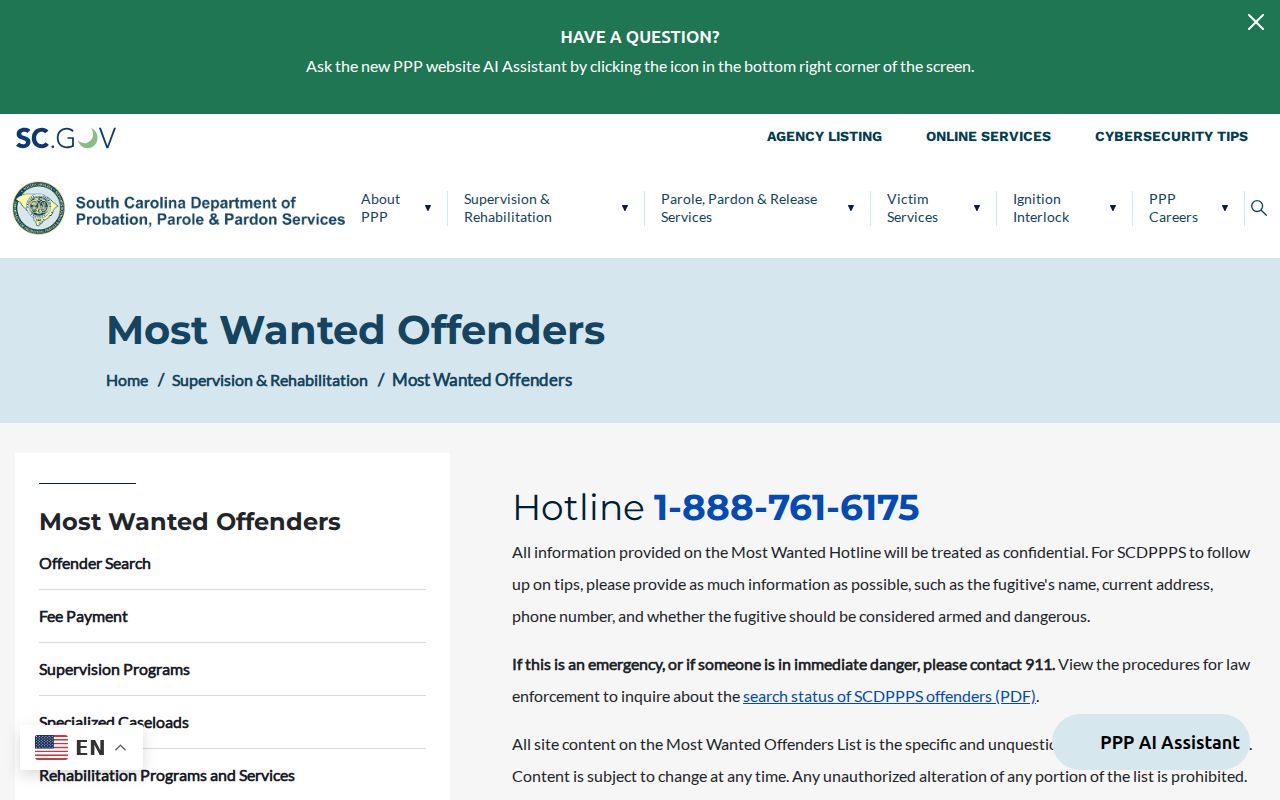
Keep the scope clear: The SCDPPPS page is a supervision absconder program, not a complete active-warrant list. Use the official page for its current tip instructions and confirm a personal case with the issuing court.
Don't copy names, photos, or roster entries from that program into a separate list. A listing never tells the full court record. Removal from a curated page is no proof that a separate South Carolina warrant was recalled.
South Carolina Warrant Lists Have Narrow Roles
Other South Carolina fugitive channels have narrow missions of their own. The SCDC Criminal Investigations unit pursues fugitive leads involving escaped inmates. Local warrants sit outside its scope, and the SCDC inmate search excludes fugitives. The agency does advertise a reward for tips leading to a capture, but that channel is not a warrant database. SLED's Blue Alert program is an alert process, reserved for qualifying threats that involve law enforcement and a wanted subject entered in NCIC. It posts no searchable roster. Federal fugitive notices and the Carolinas Regional Fugitive Task Force form yet another layer, not a substitute for the state or county court file. Each channel exists to take tips, send alerts, manage correctional cases, or chase federal fugitives. None of them supports the claim that South Carolina publishes every active warrant. And none is a tool for checking a relative's court status or arranging an appearance. If you see an immediate threat, call 911. Never approach someone because a public notice names them.
When Your Name Is on the Warrant List
A South Carolina result that looks like your case still needs the issuing court's confirmation before you pay anything or set an appearance. Ask the county Clerk of Court what the record actually says. Confirm whether the warrant is still active. Get the case number and type, any bond or no-bond condition the court can share, and the action the court approves. A match can be stale, or it can belong to someone else with a similar name. Then talk with a South Carolina attorney about a missed hearing, a motion to recall, a controlled court appearance, or a surrender plan. Law enforcement may serve a warrant at any encounter, and the state sets no universal walk-in process. Posting bond can meet a release condition without ending the underlying case. Recall and quash are different things. Quashed means the warrant is set aside, while recall means the court withdraws its process. Either decision rests with the court alone.
Before acting: Confirm the record with the issuing court and seek legal advice about the next step; an online entry alone does not show the full case or its release terms.
Confirm a South Carolina Warrant Directly
Start by pulling together what you already have. Case papers, the ticket, the county or city, and any known hearing date all help. The warrant lookup channels can point you toward a possible case. Then call the court listed as the case agency. A South Carolina General Sessions matter runs through the county Clerk of Court. A city ticket may need the Municipal Court clerk. A lower-court criminal matter may sit with a Magistrate Court, while family cases follow the Family Court route. Once you reach someone, ask which office holds the current record and whether the sheriff or city police carries service responsibility. County contacts begin with the South Carolina County Directory; for a city court, contact the municipality too. If staff withhold details, ask about a narrow public-record request. Never treat a missing listing, an old page, or an unverified name match as proof a case is clear. After a South Carolina court acts, confirm that notice reached the serving agency and ask whether any separate court date remains. Keep the recall information on hand for later calls. South Carolina has no single state warrant desk that finishes this confirmation for every county and municipality. Note: A clerk can confirm the current court record; the serving agency can confirm its own service status.