
Inside the South Carolina Warrant System
South Carolina's courts split the work. A case may begin in Magistrate Court or Municipal Court and later move to the Circuit Court's Court of General Sessions, while Family Court handles family and juvenile matters, including support-related process. The Clerk of Court keeps General Sessions files. Each lower court keeps its own records. County sheriffs, municipal police, and other authorized officers receive process for service. On the state side, the Judicial Branch's Trial Court Public Index helps locate case information from participating courts, but it is not a uniform warrant register and municipal participation is partial. SLED's criminal-justice systems serve authorized users only, and the separate SLED CATCH service is a criminal-history check that expressly excludes wanted-person information. To confirm a particular warrant, identify the issuing court and serving agency through the county directory.
South Carolina's Restricted Warrant Systems
SLED, the South Carolina Law Enforcement Division, administers criminal-justice information access for authorized agencies. Its CJIS program describes shared state information and the state's SCIEx replication of local incident reports, citations, and case files. SLED's NCIC Unit supports agency terminal access, training, and audits. None of that builds a public self-search for active warrants, and no public field list or statewide claim that every county warrant is entered exists. SLED also coordinates alerts and fugitive-related work. It is not a civilian warrant desk. Its criminal-history service cannot certify that a warrant exists or has cleared, so a local status answer still comes from the issuing court and serving agency.
South Carolina Law Enforcement Division
State criminal-justice information administration and alert coordination.
803-737-9000
If you are in immediate danger, call 911. Do not approach someone described in a public alert. South Carolina's Blue Alert program is an alert mechanism tied to qualifying threats and wanted status in NCIC, not a public warrant search. SLED CJIS information describes the authorized-user role and offers no public wanted-person queries.
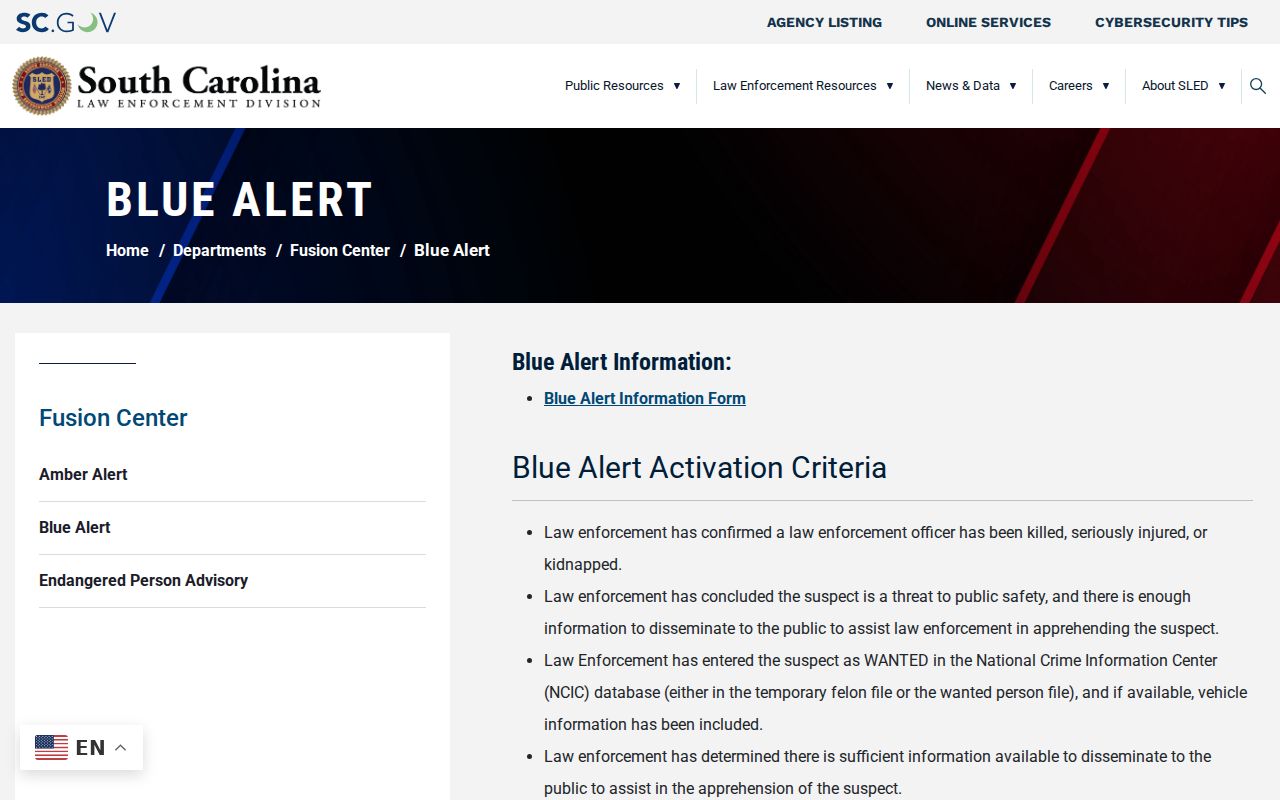
That page covers alerts and public tips. It offers no list for checking a South Carolina warrant against your own name.
South Carolina Statewide Warrant Databases
Several South Carolina services can look statewide while answering different questions. None is a public comprehensive warrant database. The table separates court-case search, restricted law-enforcement data, criminal-history reports, and traffic-ticket lookup, so a blank or positive result is never read as a warrant decision.
| System | What It Indexes | Run By |
|---|---|---|
| Trial Court Public Index | Participating-court case information; not certified warrant status | South Carolina Judicial Branch |
| SLED CJIS / SCIEx | Criminal-justice information for authorized users; no public self-query | SLED |
| NCIC | Restricted national law-enforcement system; public access is not available | FBI and authorized agencies |
| SLED CATCH | Paid South Carolina criminal-history check; wanted-person data is excluded | SLED |
| Traffic Ticket Search | Supported summary-court and participating municipal ticket matters | South Carolina Judicial Branch |
Start with the Trial Court Public Index for participating-court case entries. It does not prove a warrant is active or absent. For a ticket, the Judicial Branch's Traffic Ticket Search covers supported matters only. The South Carolina issuing court and serving agency must answer the warrant question.
South Carolina CATCH Does Not Confirm Warrants
SLED CATCH gets mistaken for a wanted-person search because it is a name-based state service. It is not one. The stated purpose is a criminal-history check. The online form asks for a last name, first name, and date of birth; a Social Security number is optional. SLED says expressly that CATCH excludes wanted-person information, so a result cannot confirm an active warrant and a no-result search cannot clear one. The standard online check is listed at $25 plus the current service fee. SLED's page identifies a $1.43 online service fee effective July 1, 2026, while older body text still says $1, so check the live checkout rather than trusting stale copy. Eligible charity or school requests in South Carolina pay a reduced $8 fee plus the service charge. These are criminal-history fees, not warrant fees. Mail applicants use the official form and the payment types SLED accepts. The paper form calls for a self-addressed stamped envelope and lists no processing time or government-ID field. A certified or notarized copy must be requested. The Public Dissemination Unit handles CATCH questions, never warrant confirmation. SLED CATCH shows what the public service covers, and a warrant status question still goes to the South Carolina court and the sheriff or police responsible for that case. The distinction matters when a person sees "no record" and assumes no court process; CATCH's exclusion notice is explicit, so use it only for its stated criminal-history purpose.
No South Carolina Warrant Feed Schedule
South Carolina publishes no county-by-county warrant feed, no public date range, and no universal refresh schedule. No state rule promises real-time or overnight updates to a public warrant list. A case index can show a docket event. The local service record moves on its own track. Other public timing rules answer narrower questions. A supported traffic citation may take three to five business days to appear in the ticket service, and a South Carolina FOIA request runs on statutory decision and production windows. Neither timeline promises a warrant will enter or leave a public index by a set hour. So go to the source. For a recent hearing, payment, or recall, ask the issuing clerk what the court recorded and whether it sent notice to the serving agency. A blank search is not that confirmation. The Public Index help material explains the court-case search. It publishes no warrant-entry cadence.
How South Carolina County Warrants Reach the State
South Carolina runs no universal public feed from every court and sheriff into a single warrant index. The court creates the case and keeps the docket. Service falls to the sheriff, a municipal police department, or another authorized peace officer. Agencies may use restricted systems under their own rules. Entry into SLED or NCIC is not automatic or universal.
Documented public route: issuing court record › clerk or court staff › serving sheriff, municipal police, or authorized officer › case-specific confirmation with the record holder
Rule 118 gives the Clerk of Court a duty. The clerk keeps a list of active county General Sessions bench warrants, each with the defendant's name, issue date, and status. The rule also sets reporting. Warrant counts and age information go to the chief judge, and originals or certified copies go to law enforcement for service. That list is a court-administration record. It is not a public statewide list, and it feeds nothing for magistrate, city, Family Court, sheriff, or federal warrants. Public Index has its own gaps. A municipal case may be missing because that court does not participate. Sealed or juvenile matters carry access limits. A recent action may lag in a connected docket, so confirm the court agency and service office through the county or city route.
South Carolina General Sessions Bench-Warrant List
South Carolina Criminal Rule 118 builds an administrative process around General Sessions bench warrants. The Clerk of Court keeps the county list. It lists the name, the warrant issue date, and its status. At the start of each term, the clerk reports the number and age of outstanding warrants. The rule goes further, covering delivery to law enforcement, reasonable service efforts, officer returns, and notice when the court lifts or dismisses a warrant. So the court and the serving agency stay coordinated. Rule 118 is not a public search service, though, and it supplies no uniform statewide status code. The docket and the sheriff's service copy can differ. A General Sessions case in a public index is just the start. Call the county Clerk of Court. Ask about the warrant's current disposition. Other courts keep their own records. A Magistrate Court bench warrant stays with that summary case, while a city ordinance or traffic matter sits with the Municipal Court. Family Court handles separate support and juvenile duties. The proper clerk follows the court that set the hearing or entered the order. South Carolina Criminal Rule 118 describes the General Sessions procedure in full. Use the right county or city contact. Note: Rule 118's county list supports court administration and does not guarantee a public statewide warrant search.
Fugitive Warrants and the US Marshals
Federal warrants follow their own court and service chain. The U.S. District Court for the District of South Carolina is the federal trial court. The U.S. Marshals Service hunts federal fugitives. It executes federal process too. Authorized state and local partners sometimes assist. A federal docket may show public entries through PACER. Sealed filings stay private. Unserved warrant details are not a public warrant roster. The Carolinas Regional Fugitive Task Force is a Marshals-led operation covering North and South Carolina. USMS says it began in January 2018. A 2024 release reported more than 8,900 fugitive arrests since its start across the region, not South Carolina alone. That figure is regional context. It is not a state warrant total. Federal Criminal Rule 4 covers arrest warrants built on a complaint and probable cause; Rule 41 covers federal search warrants. A state case does not become federal just because someone crosses a state line, and extradition and interstate rendition follow separate procedures, including South Carolina Title 17, Chapter 9. For a possible federal warrant, use counsel and official federal court or USMS channels. District of South Carolina court information and the Carolinas Regional Fugitive Task Force page describe the federal layer. Note: The task-force arrest count spans a two-state region and should not be read as South Carolina-only data.
South Carolina Municipal Warrants Stay Local
Municipal courts in South Carolina handle city-ordinance matters along with qualifying traffic and summary offenses, and each one keeps its own local record. Service may run through city police. The Judicial Branch's Public Index help material names the municipal courts that take part, but participation is partial, so that list is not a county-by-county coverage map of city warrants. Don't assume a city warrant lives in the county sheriff's records. Under S.C. Code §22-5-190, certain municipal warrants served outside the issuing municipality follow an endorsement and execution route through a magistrate where the person is found. That process connects courts across boundaries. It still doesn't create one public city-and-county warrant search. For a traffic or ordinance matter, ask the municipal clerk and city police which record controls; a county Magistrate case runs through its own clerk and serving agency. The county directory helps you find the county layer, though a city case also needs the municipality itself. Sumter shows how the split works, without promising any status: its Municipal Court page separates case information from ticket, criminal, and warrant payment links, and the page never claims those links certify whether an active warrant remains. City participation in a case index doesn't turn that index into an active-warrant register for South Carolina municipalities.
South Carolina Statewide System vs County List
A statewide case index and a county warrant record answer different questions in South Carolina. Public Index can help you find a participating court case. A local sheriff page, where one exists, may show only what that office reports and releases. Neither works as a complete warrant certificate for the state. The controlling status sits with the court that issued the process and the agency serving it, so confirm there.
| Feature | Statewide System | County Warrant List |
|---|---|---|
| Source | Participating-court case entries or restricted agency records | Issuing court and assigned service agency |
| Coverage | Not a complete public warrant feed; court participation varies | Case-specific local process and service information |
| Record authority | Useful lead or index; not a warrant-status certificate | Clerk and serving agency confirm their current record |
| Access | Public case information or authorized-only systems, depending on tool | Contact the court or sheriff/police for releasable status |
To follow a South Carolina case, search the court information available for the likely case, then contact the issuing clerk and the serving office. A blank index result means little. It may reflect a nonparticipating city court, a protected record, timing, or a local file that is not published. Use the county directory to reach the right county, and identify the city too when the case came from Municipal Court.
South Carolina Warrant Inventory Scope
A July 2026 report from South Carolina prosecutors puts pending General Sessions warrants at 168,043 on a July 1 count date. One court tier produced that number. One report did too. Some matters sit in diversion or treatment programs, and others have been transferred, so the figure is not a tally of every executable warrant in the state. Treat it as a snapshot of a single tier instead.
The 168,043 figure is not an all-warrant total. It does not include a verified statewide count of Magistrate, Municipal, Family Court, federal, or correctional fugitive process.
The report's age bands describe the pending General Sessions inventory, not how fast a particular sheriff or court refreshes a public page. South Carolina publishes no comprehensive warrant feed and sets no universal update schedule. Use the number as workload context only. Anyone checking a specific case still needs the issuing clerk and serving agency, reached through the county directory and the city route when relevant. An inventory can show court workload while leaving local warrant status to the court that issued the process. Read the prosecutors' July 2026 report for its date and scope qualifications.
South Carolina Warrant Technology and History
South Carolina's public technology story is the growth of court-case access, not the launch of a public warrant register. The Trial Court Public Index connects to the trial court case-management environment and exposes selected case information. Its help material, updated September 8, 2026, describes search controls and participating municipal courts, but that update announced no statewide active-warrant search. The Judicial Branch also offers a Court Roster Search, a courthouse locator, and a traffic-ticket search, each built for a different task: finding a court, locating a case, or looking up a supported ticket. Paying online doesn't prove a bench warrant was recalled. A docket update and a law-enforcement service return are not the same record, and SLED CJIS and NCIC stay restricted to authorized users. There is no universal county feed, published update cadence, launch date for a public active-warrant database, or public warrant status code list, so don't assume real-time or overnight updates.
Recent legal changes touch only particular record groups. Act 205, effective May 18, 2026, amended juvenile information confidentiality. Act 59, enacted in 2025, added investigative-warrant procedures for electronic communications and specified investigations. Neither creates a public warrant-search service. For a public-record question, consult Court Access Rule 10 and request releasable records from the proper holder. The state keeps court, ticket, license, criminal-history, and fugitive channels separate because each does a different job. Anyone checking a specific South Carolina warrant should trace the court, then confirm with its clerk and service agency; the public court search routes and informs, but it is not a warrant clearance service.