
South Carolina Traffic Warrants Explained
A traffic ticket is a court document that names a charge and directs the person to appear, or post any required cash bond, by a certain date. Miss that date and the issuing court keeps the case open. It may then issue bench process. A warrant does not follow automatically from every unpaid ticket, so the court record, the bond terms, and the recall steps all turn on the specific case. In South Carolina, traffic and ordinance matters usually land in Magistrate Court or Municipal Court. Municipal judges hear city-ordinance and qualifying summary offenses, traffic included, while magistrates handle summary criminal and traffic cases, and each court keeps its own lower-court records. A county sheriff or city police may receive the process for service. A statewide ticket search still cannot replace the issuing court's confirmation.
When a South Carolina Traffic Warrant Starts
Missed a traffic date? Find the court first and ask what happened on the docket. A missed date can lead to a bench warrant. That does not make every citation a warrant, and the court's file controls. Keep the ticket, the notice, the citation number, and any payment receipt at hand when you call. South Carolina law also treats willful nonappearance as a separate offense. Under S.C. Code §56-25-40(b), willful failure to appear on a Uniform Traffic Citation, without the required bond or continuance, is a separate misdemeanor carrying up to $200 or 30 days. A missed courtesy summons runs on a different rule: under §22-5-110(B)(3), a court may issue an arrest warrant in certain cases where the sworn statement establishes probable cause. These paths stay distinct, so do not assume either one from an empty search result.
- FTA
- Failure to appear when ordered by the court.
- Bench warrant
- A court order connected to a pending case, often after a missed required appearance.
- Recall
- A court action withdrawing its warrant; payment alone does not prove it was entered.
Note: A new ticket, an FTA charge, and a bench warrant are related possibilities, not interchangeable entries in one South Carolina record.
South Carolina FTA and License-Hold Systems
South Carolina has no comprehensive public statewide FTA or active-warrant search, and no statewide pay-or-lift vendor exists. The public tools answer other questions. The Trial Court Public Index shows case data from some courts, with only partial municipal participation. SLED CJIS and NCIC are restricted to authorized law-enforcement users. SLED CATCH is a paid criminal-history service that expressly excludes wanted-person information. None of these confirms an active traffic warrant.
| System | What It Holds | Run By |
|---|---|---|
| Trial Court Public Index | Some participating court case entries; it is not a warrant register. | South Carolina Judicial Branch |
| Traffic Ticket Search | Supported summary-court tickets and participating municipal tickets, not warrant status. | South Carolina Judicial Branch |
| Traffic-compliance license action | Possible suspension or refused renewal after qualifying court notice; separate from warrant status. | South Carolina Department of Motor Vehicles |
| Issuing court record | The citation, docket, warrant status, and court-directed recall steps. | Municipal Court or Magistrate Court clerk |
South Carolina Ticket Search Limits
The Judicial Branch's Traffic Ticket Search finds and takes payment for supported tickets, but it does not confirm a warrant statewide. You can search by citation number, by driver's-license number with the issuing state, or by first name, last name, and date of birth. Coverage runs to supported Summary Court traffic cases plus some participating Municipal Court tickets, so unsupported or unentered citations may not appear. Those fields lead to a ticket record, nothing more; the result is not a license history or a warrant-status record. The state payment instructions note that a new citation can take three to five business days to enter, an estimate about ticket entry only rather than any warrant update or recall timeline. The South Carolina ticket portal offers several ways to locate supported tickets, and its limited scope matters most after a missed court date.
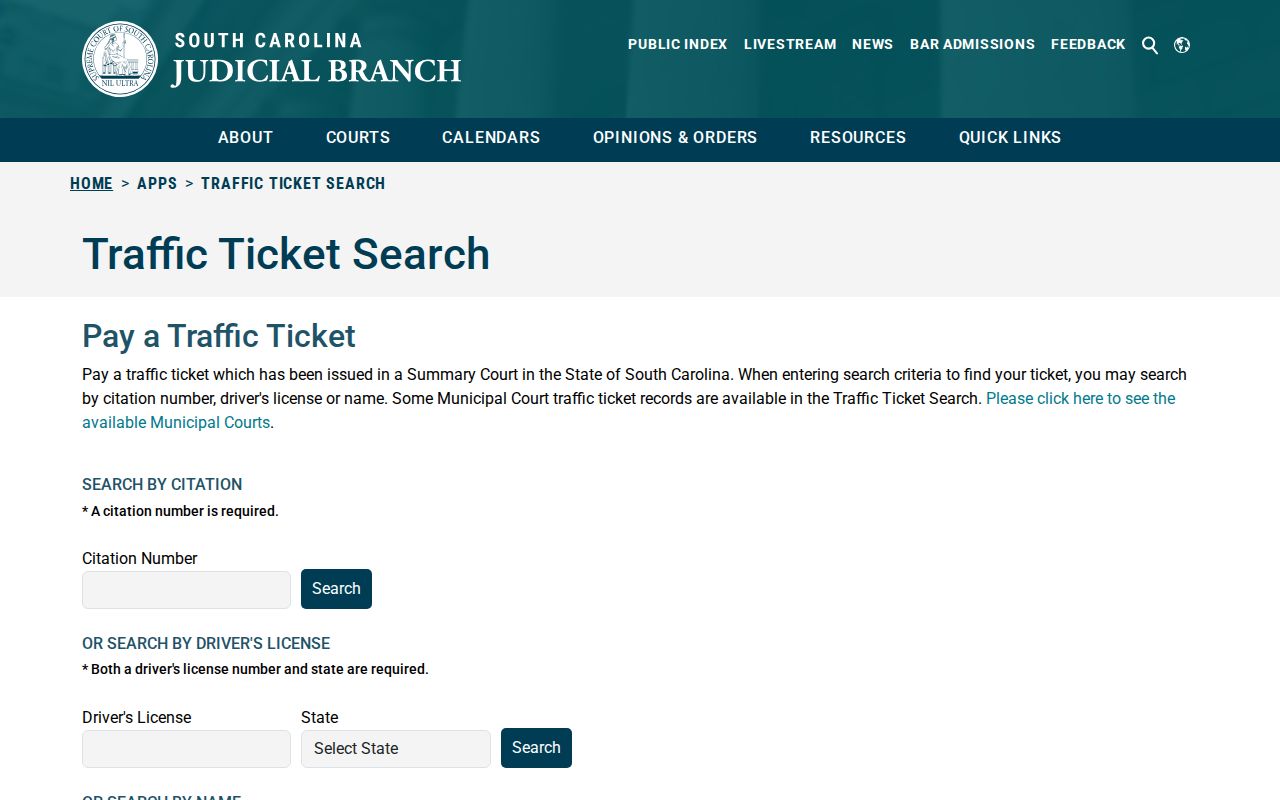
A ticket result can help identify the court and case. For an active warrant or proof of recall, contact that South Carolina court directly.
Checking for a South Carolina Traffic Warrant
South Carolina has no public statewide FTA or warrant search, so use a ticket portal only as a lead. Then check the court record and ask the serving agency about local process. A traffic matter may belong to a city Municipal Court or a county Magistrate Court. The municipality matters as much as the county.
- Gather the citation and court notice. Note the case number, city, county, and missed date if known.
- Use the Court Roster Search or Public Index to locate a court or case lead. A result does not certify warrant status.
- Contact the Municipal Court or Magistrate Court clerk that handled the ticket. Ask whether a warrant was issued and what the judge requires.
- Use the South Carolina county directory for county court and sheriff routes. For a city citation, ask the municipal clerk or police department too.
- If online sources do not confirm status, ask the court and serving agency directly. Request releasable records under the South Carolina Freedom of Information Act if needed.
A county sheriff may hold or coordinate warrant service, and public search options differ by county. A sheriff's list cannot settle a city-court question outside its own scope. No single phone line covers every court. No online result does either. Note: If the clerk cannot confirm online, the serving sheriff or city police can explain the local South Carolina service route.
South Carolina License Holds Are Separate
A license suspension and a court warrant are separate records, decided by different offices. Under §56-25-20, SCDMV may suspend a license or refuse renewal in qualifying Nonresident Violator Compact cases reported within 12 months of citation issuance or adjudication. A suspension is a license consequence, not proof that the court issued an arrest warrant. To reinstate, the driver must show satisfactory compliance and provide any further court order. The fee under §56-1-390 applies, and SCDMV lists $100 per suspension unless another fee applies. That amount is not a ticket fine or a warrant-recall charge. The court decides the case; SCDMV handles the license action once it receives the required proof.
Keep the records distinct: a license hold can exist without a confirmed warrant, and a warrant question still belongs with the court that issued it.
Note: Court compliance and South Carolina license reinstatement may require different proof and different offices, so keep confirmation from both.
How to Lift a South Carolina Traffic Warrant
South Carolina keeps payment, warrant recall, and DMV reinstatement separate. The court may take payment, set a hearing, require an appearance, or direct another action for the case. Paying online does not show that a prior warrant was recalled. Ask the issuing clerk what must happen and how the docket will show it.
- Confirm the citation and court. Ask about active status, bond, and appearance terms.
- Follow the court's direction. Pay, appear, or request a plan or hearing if offered.
- Ask whether a separate recall order is needed. Confirm how the court records its disposition.
- Get court confirmation of compliance. Then contact SCDMV about the hold and reinstatement.
- Keep receipts and recheck both offices. South Carolina publishes no statewide warrant-update interval.
If the court sets bond, ask which type applies. Ask where it is accepted and what date follows. Blank South Carolina bail forms show cash, cash-percentage, and surety options. The judge sets the terms for the case. Bond may secure release while the case stays open, but it does not dismiss the charge or complete a separate DMV reinstatement.
Caution: A ticket receipt, court recall, and SCDMV reinstatement prove different steps; confirm each record with the office that controls it.
South Carolina Warrant Confirmation Channels
Start online, but do not stop there. South Carolina's Trial Court Public Index pulls case entries from participating courts. Not every municipal court is listed. A county sheriff may run a local search, hold warrants, or coordinate service. Public channels vary by county. City matters may sit with the municipal clerk and police. For a traffic warrant, call the issuing clerk first and ask whether it remains active. Ask what action recalls it. Ask whether a court date or bond term is still set. Ask whether the court told the serving agency or SCDMV. A sheriff or city police contact can explain service or a voluntary appearance. The court controls the case record. If sources disagree, go to the court for direct confirmation. The Public Index connects to the Trial Court Case Management System, and it is a case index rather than a public warrant register. South Carolina offers no public statewide active-warrant database. The Judicial Branch updated its Public Index search help on September 8, 2026, describing case-search features and participating municipal courts, but that update concerns court-case access and does not create a statewide warrant search.
South Carolina Ticket Entry Can Take Time
A new ticket can take three to five business days to appear in the payment workflow. That estimate helps when a ticket is missing. It says nothing about a warrant, compliance, or status. South Carolina publishes no statewide warrant-status interval. If the ticket is not found, contact the issuing Municipal or Magistrate Court. Do not assume the case is closed. A written South Carolina FOIA request can seek releasable docket, warrant, service, or return records. Send it to the body that holds them. The usual determination period is 10 business days, or 20 for records over 24 months old; approved records are generally due within 30 calendar days, or 35 for older records. Exemptions and redactions may apply, and a FOIA request is not a same-day status check.
How a Traffic Warrant Differs From a Driver Record
A traffic warrant is court process for one case. The issuing court keeps the file and controls recall. A South Carolina license suspension is an SCDMV matter. A traffic citation may link the two records, but neither replaces the other. Resolving a warrant does not complete DMV reinstatement, and paying a DMV fee does not close the court case.
| Feature | Traffic Warrant | Driver Record |
|---|---|---|
| Record | Court order and docket for the cited case | License status and driving-history record held by SCDMV |
| Who controls it | The issuing Municipal or Magistrate Court | South Carolina Department of Motor Vehicles |
| What resolves it | Court-directed payment, appearance, or recall | Required compliance and any DMV reinstatement process |
| Where to confirm | The issuing court and serving agency via the county directory | SCDMV for license status, not warrant status |
South Carolina courts answer warrant questions. Send license-status questions to SCDMV, since a driver-history file is not a substitute for court confirmation.